I meant to include an author’s note at the back of Everything but the Earl to talk about Wales and castles and things, but I didn’t get it written in time, so I figured I’d post some notes here, should you want more information about a bit of the setting and history in the novel.
My great-great-grandfather emigrated to the U.S. from Wales in 1881. He and his brother came to the States to find work. (He ended up marrying an American girl whose family had deep roots in the States, but that’s maybe a story for another time.) My family has long been proud of our Welsh roots. My mom speaks some Welsh and sang in a traditional Welsh choir for a time. (I’ve been trying to DuoLingo Welsh, but so far I’ve only retained how to introduce myself and that the word for dragon is draig; I put a joke about that in the novel because draig is the first word DuoLingo teaches you, so I had Owen’s aunt teach Grace that first.) Most of the family has been to Wales to meet our extended family, who live in a little seaside town on the north coast near-ish Penmaenmawr that is about where I put the little cottage Grace uses as a studio in Everything but the Earl. I’ve been doing genealogical research, so I can say for certain that my ancestors were kicking around that part of Wales, working as fishermen and laborers, around the time the novel takes place.
While I was drafting the novel, I read an article about how some actual Welsh people are annoyed their culture is being coopted for fantasy novels, but I hope I didn’t bungle anything too badly here. I’m a little Welsh on my dad’s side, too—my third great grandparents were from central Wales—so I’m trying to honor those ancestors.
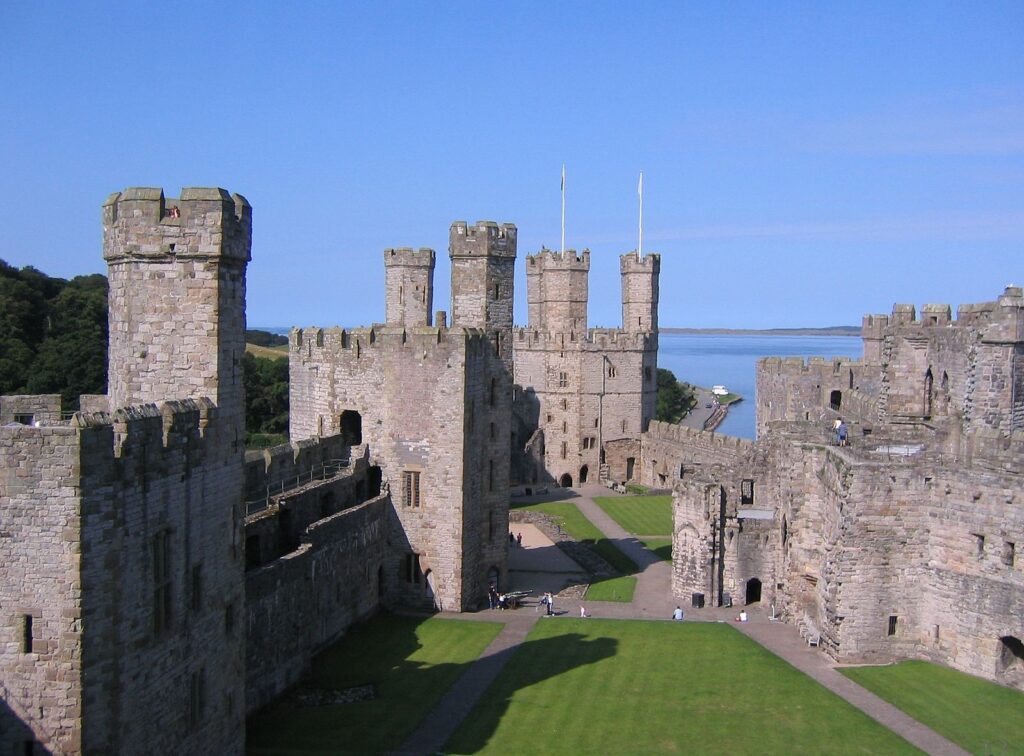

I did fudge some things, though. I believe Caernarfon Castle is owned by the Welsh government; you’ll recall it as being the place where Charles III was invested as the Prince of Wales. Now it’s a UNESCO World Heritage Site. (As I say in the book, the castle was built by King Edward I—Longshanks, the villain of Braveheart, if you’re familiar—and was the birthplace of his son Edward II, the first Prince of Wales. The Welsh had insisted there would be no English-speaking Prince of Wales, but the infant Edward II didn’t speak anything, so Edward I found a loophole, and every eldest son of the British monarch has been the Prince of Wales ever since.) The Earl of Caernarfon is an invented title (although the 5th Earl of Carnarvon was a real man who helped discover the tomb of King Tut). I made up a lot of the details.
I also decided, in this book, that Owen would take up his inherited seat in the House of Lords—a reason to stay in London—which means he had to deal with some political issues of the day. The Luddite rebellion did happen around this time; a group of textile workers who’d been replaced by machines rose up to destroy those machines, and this is why we call those who are reluctant to embrace technology now “Luddites.” (I added a bit, too, about George IV wanting to build more direct roads between the Crown’s properties in London, which was a real thing he intended to do.)
So that’s some of the history in the book. I did a lot of nerdy research for it, and I hope you enjoy!